
Record the visible inputs
We identify the person photo, clothing reference, requested outfit direction, and preservation priorities. This gives the review a clear question instead of judging the result only by whether it looks attractive.
Our evaluation checks visible consistency, clothing direction, image integration, artifact risk, and honest claims. It is a practical visual review, not proof of physical fit or a laboratory benchmark.
Each published transformation example combines an adult person photo, a clothing reference, and an AI-generated result. Before judging quality, we define the intended change: the garment category, broad silhouette, color or material direction, and the source details that should remain recognizable. This prevents a visually dramatic result from receiving credit when it no longer answers the original request.
We begin with the complete image because outfit editing is a composition problem. The face, body position, camera angle, crop, background, and light establish the visual context for the new clothing. After that broad comparison, we inspect smaller areas that commonly reveal generation errors, including hands, collars, garment edges, buttons, patterns, jewelry, hair boundaries, and contact shadows.
The review is qualitative and visible. It does not use body measurements, physical garments, spectrophotometers, fabric testing, retail inventory, or hidden product construction. It also does not guarantee that another photo, prompt, resolution, or model version will produce the same result. Examples show a workflow and evaluation method, not a universal performance claim.
The same order helps reviewers separate broad composition issues from small visual artifacts.
We identify the person photo, clothing reference, requested outfit direction, and preservation priorities. This gives the review a clear question instead of judging the result only by whether it looks attractive.
We compare identity, pose, crop, background, light direction, and broad silhouette before zooming into details. A result that changes the whole scene is not treated as a controlled clothing edit.
We check faces, hands, collars, sleeves, waistlines, hems, closures, patterns, logos, jewelry, hair edges, contact shadows, and background boundaries at a useful viewing size.
Captions distinguish visible strengths from uncertainty. They do not claim physical fit, exact product reproduction, verified fabric, commercial readiness, or a guaranteed outcome from another generation.
Each criterion addresses a different way an image can appear polished while still being inaccurate or unsuitable for its intended context.
Does the output keep the adult subject recognizable without avoidable changes to facial features, hair, expression, skin tone, or body proportions?
Do the body position, hands, camera angle, crop, background, and depth cues remain consistent with the source photo?
Does the output reflect the reference garment's broad category, silhouette, color, material cues, layering, and intended occasion?
Do fabric folds, contact points, shadows, highlights, perspective, and garment edges respond plausibly to the person and scene?
Are there visible problems around hands, collars, closures, logos, repeating patterns, jewelry, hair, accessories, or background boundaries?
Does the caption avoid claiming exact fit, size, construction, product identity, or commercial suitability that the image cannot verify?
This current homepage example places the adult model, floral outfit reference, and generated catalog direction in one visual. A useful result needs to preserve identity, pose, proportions, and studio light while integrating the new garment construction.
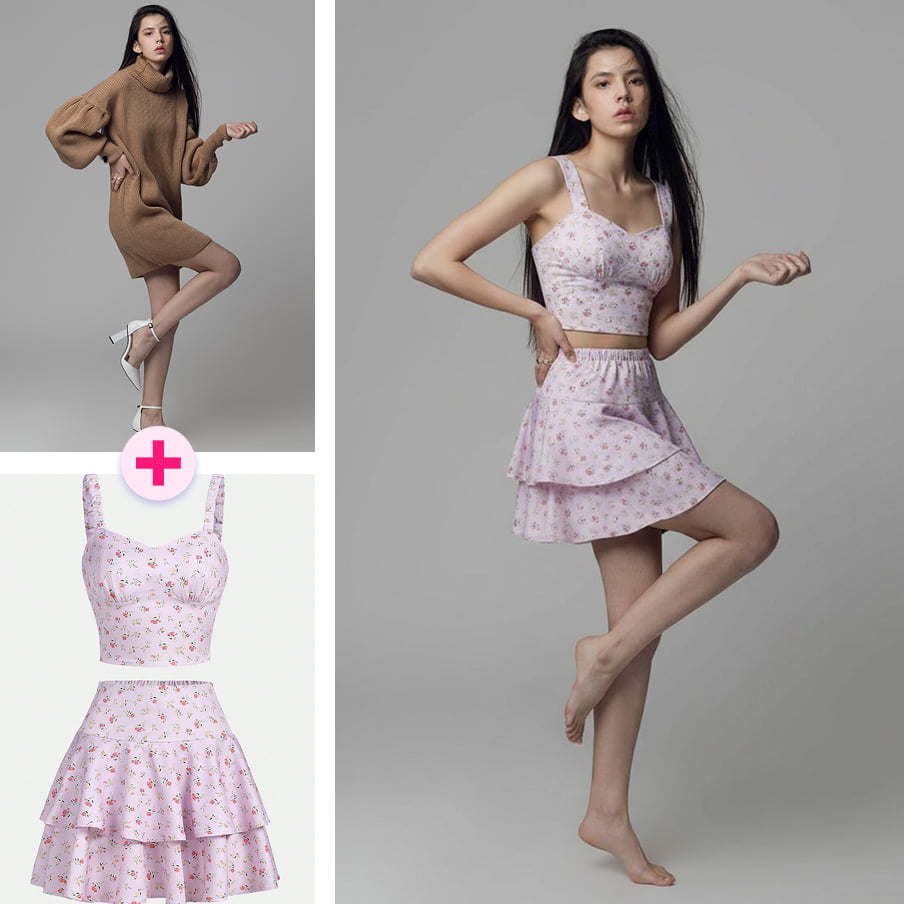
Start with the face, hair, stance, camera angle, and studio background. Then inspect the neckline, shoulder placement, waist construction, floral detail, hem, hand boundaries, and contact shadows. Compare the broad casual styling direction without assuming that every seam, fastener, material property, or exact color matches the reference garment.
Example captions identify the visible inputs, requested clothing direction, and parts of the original composition that appear consistent. When a detail is uncertain, the description stays broad. A generated result may communicate a navy tailored direction, for example, without proving the exact wool, construction, brand, or retail product represented by the reference.
Prompts are presented as practical starting points rather than guaranteed recipes. Users should adapt garment, material, occasion, preservation, and refinement language to their own source images. For the product purpose and responsible-use principles, read About AI Clothes Changer. For publication limits, review the AI output disclaimer and the complete outfit editing workflow.
Start with the complete composition, then inspect identity, hands, garment edges, patterns, accessories, and background details at full size before refining or sharing the result.